Review: Why Johnny Can’t Preach: The Media Have Shaped the Messengers
 Why Johnny Can’t Preach: The Media Have Shaped the Messengers by T. David Gordon
My rating: 4 of 5 stars
By the title of this book I expected it to be somewhat playful, but Gordon is all business. It is a serious subject and a serious problem, so his serious manner is appropriate. He transparently states the state of things in the average pulpit today. Though anecdotal, anyone with church-going experience can verify his unscientific findings. His concern is not that there are no great preachers today, but rather that the average pulpit in the average church doesn’t even have average preaching, but less than mediocre preaching.
Usually churches respond to this problem by trying to make up for it in other ways. They fool about with styles of music, interior design and decoration, technology, nurseries, groups, programs, etc. If they address the preaching directly it is to push for the twenty minute, one thought type of message. Gordon points out this is like a hospital having an excessive death rate in surgeries and choosing to address it by banning the use of scalpels in the operating room.
He doesn’t merely bewail the state of things but seeks to uncover the problem root. He acknowledges seminaries are imperfect, but he can’t lay the blame there. He contends Johnnies don’t have the inculturation necessary to preach well before they even enter seminary. He lists three sensibilities a man must have cultivated before he even begins to learn to preach. 1) “the sensibility of the close reading of texts.” 2) “the sensibility of composed communication.” 3) “the sensibility of the significant.”
He concludes by recommending ways Johnnies can cultivate these sensibilities. He did not set out to write the definitive work on preaching, but rather to address requisite beginning. His case is well put and compelling. Any man who is called to preach must be aware of the limitations of his upbringing in the media ecology of today and he must be deliberate about cultivating the skills required to preach well. If this book gets a man pointed in this direction, then it is well worth it.
I found some parts less compelling than others. I also scratched my head at different times. For instance, Gordon made a point of not apologizing for his classic use of masculine pronouns. So he baldly states he will be uber-conservative, traditional, and stodgy on that point. However, he makes a point of this in order to say that his old school grammarian ways are not to be interpreted to exclude women. Say what? This is a book about preachers and preaching and you make a point of saying you’re not excluding women. So in the same breath he defends his curmudgeonly use of grammar, but in service of liberal, progressive error. I think Johnny the Apostle might say, “That maketh no sense.”
I still think it’s a worthy book but reading it might be like listening to a lecture from a professor with a bad comb-over. What he is saying is important, but those flyaways can be distracting.
Review: The Art of Work: A Proven Path to Discovering What You Were Meant to Do
 The Art of Work: A Proven Path to Discovering What You Were Meant to Do by Jeff Goins
My rating: 3 of 5 stars
My thoughts on this book are mixed. It is well-written in terms of craft. The human interest stories are compelling. It does have some useful suggestions and advice, but I don’t know that it accomplished its own expectation. I am probably cynical when it comes to pursue-your-dreams and live-a-radical-life messages. So, keep that in mind.
The idea of selfless service was not absent, but it wasn’t prominent enough. There wasn’t any effort to resolve tensions. For example: it could be an act of complete selfishness and self-centeredness to leave everything and move to Burundi. It might not be so, but the tension wasn’t explored. Being published by Thomas Nelson, I expected more of a Christian worldview on vocation–finding our purpose in life is found in pursuing God’s kingdom and his righteousness first and the greatest is the least and servant of all. It seemed that kind of message was watered down and, instead, there was some fuzzy, mystical stuff about “calling” and some near motivational guru speak. The message comes across as your failing unless you’re living in some radical, unconventional way. Where does this sort of message leave the Bible’s idea of a blessed life as being a quiet peaceable life with loving family?
Again, it wasn’t all bad. Apparently, many have read it and profited from it.
Review: On Writing Well: An Informal Guide to Writing Nonfiction
 On Writing Well: An Informal Guide to Writing Nonfiction by William Zinsser
My rating: 5 of 5 stars
Everybody recommends some books because everybody recommends them. Being heard or read recommending them lends cachet in certain circles. Recommendations for those books are easy to find, but finding someone who actually read the book and can tell you what is good or useful about it is not easy. Zinsser’s book is not one of those books. Everybody recommends this book because it is excellent and worth reading.
This isn’t a technical grammar manual, but a book on writing clearly. Zinsser uses numerous examples to illustrate his points. If you read nothing else, read the chapter on clutter.
Do Hard Things
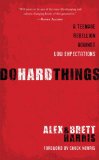
Alex and Brett Harris have a message for their generation:

Most People don’t expect you to understand what we’re going to tell you in this book. And even if you understand, they don’t expect you to care. And eve if you care, they don’t expect you to do anything about it. And even if you do something about it, they don’t expect it to last. We do.
Their powerful message is captured in these words and put succinctly in the title: Do Hard Things. They are spreading the message of “A teenage rebellion against low expectations.” The Harris brothers are challenging and exhorting their generation to rise above the ridiculously low expectations the world has for the average teenager.
This book is filled with real life examples of young people doing hard things and in ways small and large refusing the norms of society and accomplishing great things. Their focus is not just to do things that are hard, but to do worthy things that are hard.
This book is primarily written to teens, but all ages will benefit from this message. Adults also shrink back from right and worthy things because they are hard. I enthusiastically recommend this book.





Devotional Commentary
Posted by Jeff Short on December 11, 2008 · Leave a Comment
The Five Books of Moses
The Five Books of Moses by F. B. Meyer is classified as a devotional commentary. Meyer goes chapter by chapter through the first five books of the Bible. Each chapter gets roughly one to one and a half pages in the book.
The comments are not thorough and exhaustive, but they are worthwhile. Meyer touches on the major points in the chapters. In keeping with his usual style, he provides many practical comments.
Reading this book together with the Bible is a good way to use it. If you are reading through the Pentateuch, you could read Meyer’s comments on the chapter you just read and work through the whole that way. I have found this book helpful in this manner.
Share this:
Filed under Reviews, Short Booklog · Tagged with Commentary, Reviews