Worldview
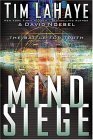

Mind Siege by Tim Lahaye and David Noebel is a reworking of an older book, The Battle For The Mind. This edition has been updated with current information. The copy I have was printed in 2000. Mind Siege is very informative about Humanism and Secular Humanism. Lahaye shows that Humanism is unquestionably the established state religion in America and that this religion is observed and honored throughout the government, public schools, big business, entertainment, and news media, etc. In short, it’s everywhere.
Lahaye also discusses the fervent indoctrination practice of Humanist adherents. They have an extremely aggressive program of brainwashing the general public in order to create good world citizens after their own image. This book is a real eye-opener and should be read by every Christian in this day. Unfortunately, we do not seem to understand who the enemies are and what the battle really is.
The only weakness to the book is that the author’s conclusions are somewhat lacking. Some of the solutions offered are not necessarily in line with spiritual warfare and the Christian commission. We have powerful weaponry in Jesus Christ and we should not abandon it to try to fight the world on their terms. While the practical applications could be more biblical and thorough, this is still a very worthwhile book. We have to know what the problem is before we can begin to address it. On that score, this book is helpful.
Blinded With Science
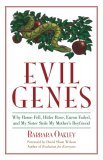

Barbara Oakley has a new book out, Evil Genes: Why Rome Fell, Hitler Rose, Enron Failed, and My Sister Stole My Mother’s Boyfriend. Oakley has a long list of credentials involving both education and practical experience, a position in academia and world travel. She has written a science text that blends adept research with personal adventure and observation. All this tends to make her book accessible to a wide audience beyond her peer group.
Her basic premise is the exploration of “human evil from a scientific perspective.” She testifies that it was her own sister’s inexplicable, ruinous behavior that caused great pain to those around her that was the catalyst in researching this topic. From the scientific side, she discusses recent advances in brain imaging and the field of genetics to understand evil in humans. She believes science is revealing new details of how our brains work and how genes influence our ability to discern between right and wrong.
Oakley obviously writes from an anthropocentric perspective. She also writes from the black tower of the last bastion of modernity in this country, though I am sure postmoderns will be willing to borrow capital to advance their humanistic goals. Her base conclusion is that evil people are genetically crippled and that makes them dangerous and/or hurtful to others, even those who love them.
I can neither recommend this book nor condone its conclusions. I think it is something we need to be aware of. Man, since the fall, has sought to put new names on sin and shift blame off themselves. Today folks have problems, issues, episodes, genetic predispositions, but not sin. This is the culture we seek to evangelize and unless they own their blood-guiltiness before God, they will not be saved.
Worldview
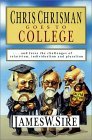

This book is helpful at identifying the worldview behind the philosophy and methods of public institutions, which is disorienting to most first-year students. Putting this information into a narrative makes it appealing to a wider audience. Sire fades in and out of the narrative with non-fiction explanations of terms and concepts, which is somewhat distracting. The story itself is real and believable enough, but the solutions are perhaps a little too simple. However, these weaknesses do not take much away from the book’s overall value. It is a good book that covers the problematic worldview of public colleges in a brief and interesting way.
******
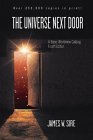

The book is very informative and worth reading. It is also good to have around for reference once you have read it.
Expository Preaching
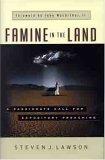

Exposition should be a part of our preaching in the church. Even when preaching topically, exposition should be used. Though there are various methods of delivering sermons, all biblical preaching will be based on accurate and faithful exposition of the Scripture. The skilled preacher will be versed in various methods, using them carefully and skillfully to best communicate the truth of God’s Word to his hearers.
Lawson’s book is worth reading and hopefully it will stir up some fire for this most excellent method of preaching.
Argument

Therefore, argument is of extreme importance to preachers. It is the preacher’s vocation to be defining, expounding, and defending the propositions of Holy Scripture. For that matter, every Christian is to conscientiously defend and contend for the faith and should be concerned about good argument evaluation and construction.
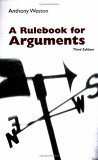
In this vein, I recommend A Rulebook for Arguments by Anthony Weston. This is a rulebook as the title suggests, but it is concise and readable. The book should be read through one time and then referred to often when analyzing or building arguments. Its brevity is one aspect of its value. You can refer to a section and quickly refresh your memory about some concept. The author does also give some sources for larger works if the reader is interested.